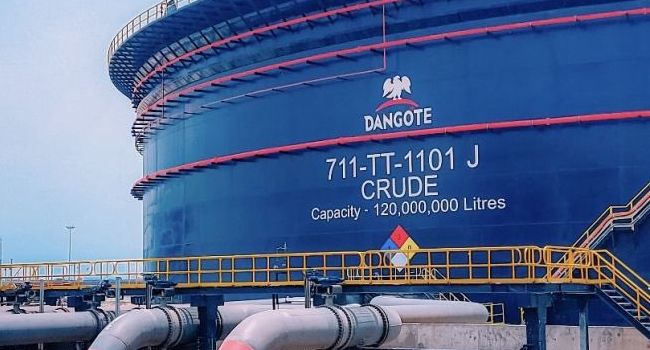
The Dangote Petroleum Refinery has announced plans to begin a nationwide distribution of Premium Motor Spirit (petrol) and Automotive Gas Oil (diesel) starting from August 15.
This was as fears of fuel scarcity mounted in Lagos and other parts of the country following the controversy surrounding the E-Call Up system of the Lagos State Government.
The tanker drivers and fuel marketers in Lagos State said on Sunday that they would stop loading petroleum products from today, saying they could not afford to pay N12,500 per truck for the E-Call Up system, especially on the Lekki-Epe Corridor.
In response, the Lagos State Government said there was no going back in the implementation of the E-Call Up system on Monday, accusing the unions of collecting up to N41,000 from drivers without any service.
Amid the brawl, the Dangote refinery, in a statement on Sunday, said the company would deploy 4,000 brand-new Compressed Natural Gas-powered tankers to boost delivery capacity and improve access to fuel across the country.
The offer, it disclosed, would be open to marketers, petrol station dealers, manufacturers, telecom operators, aviation firms, and other large-scale fuel users. The firm also announced plans to support distribution through the establishment of daughter booster CNG stations and a dedicated fleet of over 100 gas-powered tankers.
It noted that the logistics support, including free product delivery, was designed to eliminate distribution bottlenecks and bring down operational costs in key sectors of the economy.
“This strategic programme is part of our broader commitment to eliminating logistics costs, enhancing energy efficiency, promoting sustainability, and supporting Nigeria’s economic development,” the company said.
Recall that the President of the Dangote Group and Founder of the Dangote Petroleum Refinery, Aliko Dangote, once said there would be an announcement of what he called a major ‘shakedown’ in the entire country.
The initiative, which includes a credit scheme for bulk buyers of 500,000 litres and above, is expected to revitalise dormant filling stations, reduce inflationary pressure, stimulate small businesses, and support the President Bola Tinubu administration’s economic reform drive.
Dangote’s plan to distribute fuel itself could negatively impact the projected revenue at the parks built for truck drivers under the E-Call Up system.
Meanwhile, marketers expressed fear that the decision of tanker drivers to stop lifting fuel beginning from today (Monday) could trigger scarcity if nothing is done to resolve the matter amicably.
Recently, the Lagos Deputy Governor, Obafemi Hamzat, said the E-Call Up system was designed to regulate the movement of articulated vehicles and tankers accessing the Lekki-Epe corridor, thereby promoting orderly traffic flow and preventing the kind of gridlock previously experienced in the Apapa area.
The Lekki-Epe axis, which hosts critical investments such as the Dangote refinery, Lekki Deep Sea Port, and several oil and gas installations, has continued to witness a surge in industrial and commercial activities.
The Commissioner for Transportation, Mr Oluwaseun Osiyemi, had explained that the E-Call Up System was designed to prevent chaos on the roads by regulating truck movements using a structured scheduling framework, stating that under the new regime, truck operators would be required to register online and upload their Authority to Load documents.
The commissioner mentioned that only trucks that were validated and cleared would be granted access to designated truck parks, where they would await an electronic call-up notification before proceeding to their loading destinations, saying “the process is aimed at reducing illegal parking, improving traffic flow, enhancing security and safeguarding road infrastructure along the busy corridor.”
With only one major exit route in the area, the government said this growth had intensified congestion concerns.
However, the tanker drivers under the aegis of the National Association of Road Transport Owners, as well as the Independent Petroleum Marketers Association of Nigeria, said they could only pay N2,500 per truck.
In an interview with one of our correspondents on Sunday, NARTO President Yusuf Othman said the association was still in talks with the Lagos State Government to allow its members to pay N2,500 per truck instead of N12,500.
“It is not that our members don’t want to load from the Dangote refinery; there is a plan by the Lagos State Government to start the E-Call Up system on Monday, which will attract N12,500 per truck. We have requested the Lagos State Government to reduce the amount, but the government has yet to do that. Therefore, we told our members not to ply the road; they should hold on until we have an amicable resolution with the Lagos State Government.
“For now, we are still negotiating with the Lagos State Government. There is no cause for alarm for now. But if they disagree, our boys will not go and load tomorrow (Monday). We told the government that the N12,500 is too high. We recommended N2,500 from the beginning. Let’s see how it goes if we can have an amicable resolution; if not, there will be no loading on Monday,” Othman said.
Speaking, IPMAN Vice President, Hammed Fashola, told The PUNCH that marketers were not against the E-Call Up system, but the N12,500 fee. Aside from the cost, Fashola said the state government was in a hurry to implement the policy, calling on the government to listen to stakeholders.
“Let me start by saying that both the NARTO and IPMAN are not against the initiative of the Lagos State Government. We are not against it. In actual fact, we have been in discussion with them for some time. I think the only issue is the cost. And again, I think they are in a hurry to implement this system, which is not supposed to be so.
“All stakeholders have to be on the same page before they can implement it. When you want to look at the stakeholders in this sense, you look at IPMAN, NARTO, Petroleum Tanker Drivers, the refinery, and depot operators too. If you want to do a call-up system, you have to involve the refinery and the depots, because you need information from them. There must be a synergy so that all stakeholders are on the same page. All these things are not there,” he said.
Fashola faulted the condition of the parks built for the trucks, alleging that the state government had not taken stakeholders on a tour of the facility.
“As I’m talking to you today, I can speak for IPMAN. Nobody has shown this facility to IPMAN. I think sometime last year, I was part of the team that went out to look at all the proposed parks. We went to Orile, there’s one in Orele, there’s one in Mile 2. All these facilities are just like a mushroom park. They are not really built for trucks. So, we advised that they have to upgrade them.