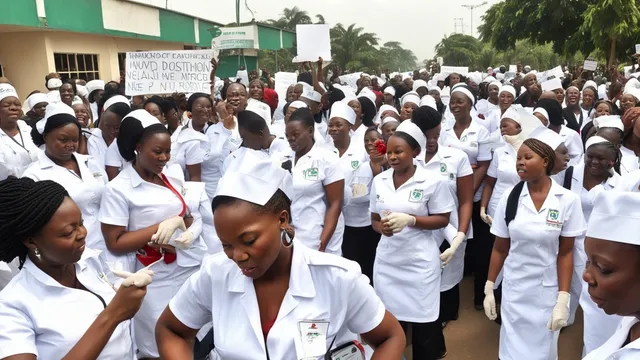
Hospitals across the country were thrown into disarray yesterday as nurses and midwives began a seven-day nationwide warning strike. Acting under the National Association of Nigerian Nurses and Midwives (NANNM), they are demanding better welfare, improved working conditions, and institutional reforms, leaving patients stranded and health services crippled in many facilities.
The union had earlier issued a 15-day ultimatum to the Federal Government on July 14, 2025, demanding immediate intervention to avert a total collapse of services in federal health institutions.
According to the National Chairman of NANNM-FHI, Morakinyo Rilwan, the government failed to respond within the specified period. Meanwhile, the Federal Government has appealed to the association to shelve the strike.
Minister of Labour and Employment, Mr Muhammad Dingyadi, made the appeal yesterday in Abuja during a meeting with the leadership of the association.
The minister urged the association to reconsider its action, insisting that “a strike is not the best solution to industrial disputes.” He appealed to the union to embrace dialogue, assuring that the government is working to address their concerns. Discussions are scheduled to continue tomorrow at the headquarters of the Federal Ministry of Health as efforts to resolve the dispute progress.
The strike forced several government hospitals in Abuja to either discharge patients or drastically scale down operations due to a critical shortage of nursing staff.
During a visit to the Federal Medical Centre (FMC), Abuja, The Guardian observed slow medical services, with long queues at the General Out-Patient Department, Immunisation Section, Consultation Section, and Surgical Out-Patient Department. Patients waited for hours with minimal care, as executives of NANNM monitored compliance with the strike.
Chairman of NANNM at the medical centre, Victor Asu, confirmed that no nurses were on duty.
“I am here today to ensure absolute compliance. Although doctors and other healthcare workers are not on strike, services have become slow, and patients are already complaining. I went to the Intensive Care Unit, and a patient is agitating to be discharged. We have resolved that no member will attend to patients in the wards or stay with them overnight. Normally, nurses provide 24/7 care, but for now, we are fully on strike,” he said.
Abu Isah, who brought his father to FMC, said they arrived at 8:00 a.m. and were still waiting after two hours.
A doctor, who spoke anonymously, admitted: “We’re overwhelmed. Without the nurses, our capacity is extremely limited. We can only offer basic care, but beyond that, our hands are tied.”
At the National Hospital, Abuja, the impact of the strike was also visible. Patients filled the waiting areas, many sitting on the floor or leaning against walls, anxiously hoping for attention. With no nurses on the ground, doctors and other healthcare workers were left to take on roles typically performed by nurses, resulting in painfully slow services.
Relatives of patients expressed frustration over the delays, but many patients chose to remain, fearing their conditions might worsen if they left without being treated.
Chairman of NANNM at the hospital, Joe Akpi, warned that the union would issue a fresh 21-day ultimatum at the end of the warning strike if their demands remained unmet, after which an indefinite strike would follow.
“Inasmuch as we care about the patients, there is nothing we can do. There is an ongoing meeting, but it has been postponed to Friday,” he said. At Wuse General Hospital, patients in the Accident and Emergency Unit were reportedly discharged as doctors struggled to cope without nursing support.
Nurses and midwives at the University College Hospital (UCH), Ibadan, have joined the ongoing seven-day warning strike declared by the National Association of Nigerian Nurses and Midwives to press home demands for improved welfare and better working conditions from the Federal Government.
The Ibadan chapter of the association resolved to join the industrial action after an emergency congress held at the hospital’s Nurse Lounge. Many of the nurses who had earlier reported for duty yesterday morning were later seen leaving the hospital premises, some removing their uniforms before heading home.
Speaking shortly after the congress, the Oyo State Chairman of NANNM, Comrade Olufunmilola Familu, listed the association’s demands. These include the employment of more nursing personnel, provision of adequate facilities in hospitals and health institutions, and the establishment of a directorate cadre for nurses at the Federal Ministry of Health.
She said, “Our conclusion is that we are commencing the seven-day warning strike, as directed by the National Headquarters of the Nigerian Nurses and Midwives, consequent upon which the federal government did not accede to our demands. So we are commencing the seven-day warning strike. Our demands include: employment of more nursing personnel and provision of adequate facilities for our various hospitals and institutions.
“We want a directorate cadre for nurses at the Federal Ministry of Health. We want fair representation of the association at the Federal Ministry of Health. We want consultancy for nurses and midwives, gazetting of the nurses scheme as established by the NCE in 2016, and then centralisation of internship training for nurses. We also want a review of the allowances for nurses and midwives.” Familu expressed concern for patients affected by the strike, noting that the decision was not taken lightly.