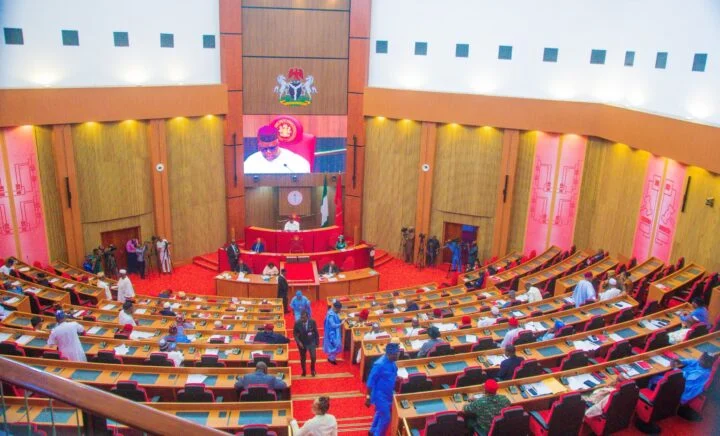
The Senate has approved life imprisonment for anyone convicted of defiling a minor, a dramatic escalation from the present five-year jail term under the nation’s criminal code.
This was as the House of Representatives launched an investigation into the utilisation of $4.6 billion in grants received from the Global Fund and the United States Agency for International Development (USAID) for Nigeria’s fight against HIV/AIDS, tuberculosis (TB), malaria and polio.
The House of Representatives also witnessed intense debate over a motion seeking to protect the Dangote Refinery and other strategic private investments from “unlawful and adversarial” labour union activities.
The Senate resolution followed consideration of the Criminal Code (Amendment) Bill, 2025, which seeks to impose stiffer punishments for sexual offences and related crimes.
Lawmakers described the defilement of minors as a “heinous act capable of destroying a child’s life forever,” insisting that the punishment must reflect the gravity of the offence.
“The Senate has decided that any defilement of a minor in Nigeria, henceforth, attracts life imprisonment without an option of fine,” Senate President Godswill Akpabio declared after a unanimous voice vote. “Let everyone be aware.”
The bill, initially passed by the House of Representatives and transmitted to the Senate for concurrence, received broad bipartisan support yesterday.
The Senate also toughened the penalty for rape and related sexual offences. Under the amended provision, any act of forced sexual intercourse involving a boy, girl, man or woman will now attract a minimum of 10 years imprisonment, compared to the previous five-year term.
Former Kebbi State Governor, Senator Adamu Aliero, had proposed life imprisonment for rapists, but the chamber settled on 10 years as the baseline punishment, leaving room for judges to impose stiffer sentences in aggravated cases.
The Senate’s reworded clause ensures that both male and female victims are recognised under the law, a change inspired by observations from former labour leader, Senator Adams Oshiomhole.
However, debate grew heated when the chamber reached the clause on abortion and pregnancy termination. While the existing law criminalises abortion and penalises anyone who procures or supplies materials to terminate a pregnancy, several lawmakers urged caution to protect medical practitioners acting in emergencies.
Senator Abdul Ningi (Bauchi Central) warned that vague language in the bill could expose doctors to criminal liability, even when they are saving lives.
Responding, Akpabio directed the Committee on Judiciary, Human Rights, and Legal Matters to conduct a deeper review of the contentious provisions within two weeks and report back with recommendations.
The move by the House to probe the grants followed the adoption of a motion sponsored by Philip Agbese during plenary yesterday, presided over by the Deputy Speaker, Benjamin Kalu.
The House subsequently mandated its Committee on HIV/AIDS, Tuberculosis and Malaria Control to investigate the utilisation of the grants received between 2021 and 2025, and to report back within four weeks for further legislative action.
In addition, lawmakers directed the Minister of Health and Social Welfare to provide the implementation plan and the National Assembly-approved expenditure details of the grants.
Moving the motion, Agbese (APC, Benue) disclosed that Nigeria also received over $6 billion in health assistance from the U.S. President’s Emergency Plan for AIDS Relief (PEPFAR) within the same period to combat HIV/AIDS and strengthen health systems.
Agbese noted that despite these substantial inflows, Nigeria still ranks among countries with the highest global burden of the three major diseases.