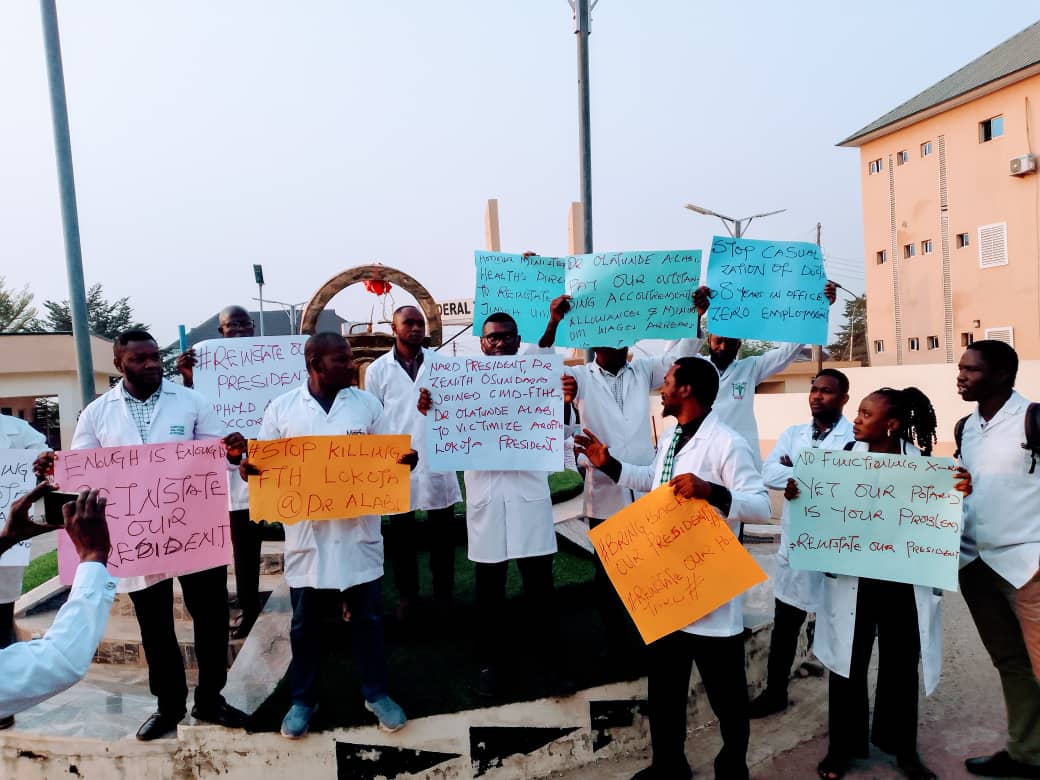
The face-off between the Federal Government and the National Association of Resident Doctors (NARD) has intensified following a dispute over the actual amount released to settle outstanding arrears owed to health workers.
Although the government claims to have released N11.995 billion to ease the ongoing nationwide strike, NARD insists that its members across 91 hospitals will not return to work until all 19 of their demands are met.
NARD President, Dr Mohammad Usman Suleiman, told The Guardian that the figures announced by the government were “very wrong” and far below what is owed. He said that while the Ministry of Finance had indeed begun processing payments under the Consolidated Medical Salary Structure (CONMESS) and the Consolidated Health Salary Structure (CONHESS), the total amount due to doctors stands at N48 billion, not N41 billion as claimed by the government.
According to him, although about N11 billion of the released funds are meant for doctors, only a portion directly benefits resident doctors. He explained that the payment categories recently cleared, including accoutrement allowance and the balance of COVID-19 hazard pay, cover just two of the association’s 19 long-standing demands.
“The 25/35 per cent arrears being discussed apply to all health sector staff, not just doctors. Out of the N48 billion, the government has so far released N41 billion, but even within that, resident doctors are receiving less than they should. We appreciate the Minister of Finance, Mr Wale Edun, for acting promptly, but the Ministry of Health should focus on taking serious and genuine actions in sorting out the issues on their own table rather than taking the success of another agency of government,” he said.
He added that the association had yet to see significant progress on other unresolved issues, including welfare improvements, salary adjustments, and conditions of service.
Across the country, the strike has disrupted hospital operations, leaving thousands of patients stranded. At the University College Hospital (UCH), Ibadan, the President of the Association of Resident Doctors (ARD), Dr Gboyega Ajibola, confirmed full compliance with NARD’s directive to embark on an indefinite strike.
“As of midnight on November 1, all our members, medical officers and resident doctors withdrew services completely. Only consultants are attending to patients, but resident doctors, who form the backbone of the workforce, are not on ground. The result is that emergency wards, outpatient clinics, and other departments are barely functioning. It’s an unhappy situation for everyone, especially patients and their relatives,” he said.
Ajibola noted that the strike, though regrettable, became inevitable after repeated failed negotiations with government officials. He said the association had issued multiple ultimatums since August, adding that doctors were “completely exhausted” from excessive workloads and poor working conditions.
“Our members are not happy to be away from their duty posts, but this strike is a struggle for the soul of healthcare in Nigeria. We cannot continue to work under impossible conditions while our welfare is neglected,” he stressed.
In Lagos, the Publicity Secretary of ARD, Federal Medical Centre (FMC) Ebutte-Metta chapter, Dr Akintade Adegboyega, said the government’s press release misrepresented the actual payments made, adding that all resident doctors nationwide had withdrawn their services.
“The strike is total and indefinite. No member of the association is working at the moment. We believe it’s unsafe for doctors who are under severe stress or poor mental state to continue attending to patients,” he said.
In Cross River State, most public hospitals in Calabar have been crippled by the strike, with only the Nigerian Navy Reference Hospital and a few private facilities still operating. A senior official at the University of Calabar Teaching Hospital told The Guardian that the industrial action had worsened the already fragile healthcare system, forcing patients to cancel appointments or seek alternative care.
“The system is overstretched due to mass emigration of medical professionals,” he said. “Consultants are managing old emergency cases, but new patients are being referred elsewhere. This is not sustainable.”
In Asaba, Delta State, skeletal operations were observed at the Federal Medical Centre, where consultants and a handful of nurses struggled to keep essential services running. Wards and outpatient units remained quiet, with several patients turned away.
A nurse who preferred anonymity said, “We are only managing those already admitted. No new emergency cases are being taken because there are not enough doctors to handle them.”
Some patients expressed frustration over the prolonged strike. One patient’s relative, Chinyere, lamented that her husband’s medications and reviews had been delayed. “They told us to come back when the doctors resume. My husband’s condition is not yet okay,” she said.
Another patient in Calabar, Mrs Nkoyo Etim, who is seven months pregnant, said she might be forced to patronise traditional birth attendants due to her inability to afford private hospital bills. “I don’t have the means to go to a private hospital. If this continues, I’ll have to seek other options,” she said.
Despite the public outcry, NARD insists it will not call off the strike until its demands are fully addressed. Dr Suleiman urged Nigerians to support the association’s struggle, arguing that better welfare and working conditions for doctors would translate to improved healthcare delivery for all.
“This is not a fight against the government,” he maintained. “It is a fight for a functional healthcare system that serves both workers and citizens. Until real progress is made, the strike will continue.”
Strike cripples National Hospital, FMC Jabi
The indefinite strike embarked upon by the Nigerian Association of Resident Doctors has paralysed activities in major hospitals across the Federal Capital Territory (FCT), leaving patients and caregivers stranded and forcing many to seek medical care in private facilities.
With visible distress, some patients lamented that the industrial action had disrupted their treatment, appealing to the Federal Government to urgently address the doctors’ demands and find a lasting solution to the recurring strikes in the health sector.
When The Guardian visited the Federal Medical Centre (FMC), Jabi, patients in the emergency ward were seen being discharged due to the absence of doctors.
An accident victim, covered in bandages and with visible injuries, was being moved into a golf cart by five men believed to be his relatives. Asked why the patient was leaving despite his severe condition, one of them replied that “the doctors are on strike, and we have decided to take him home.”