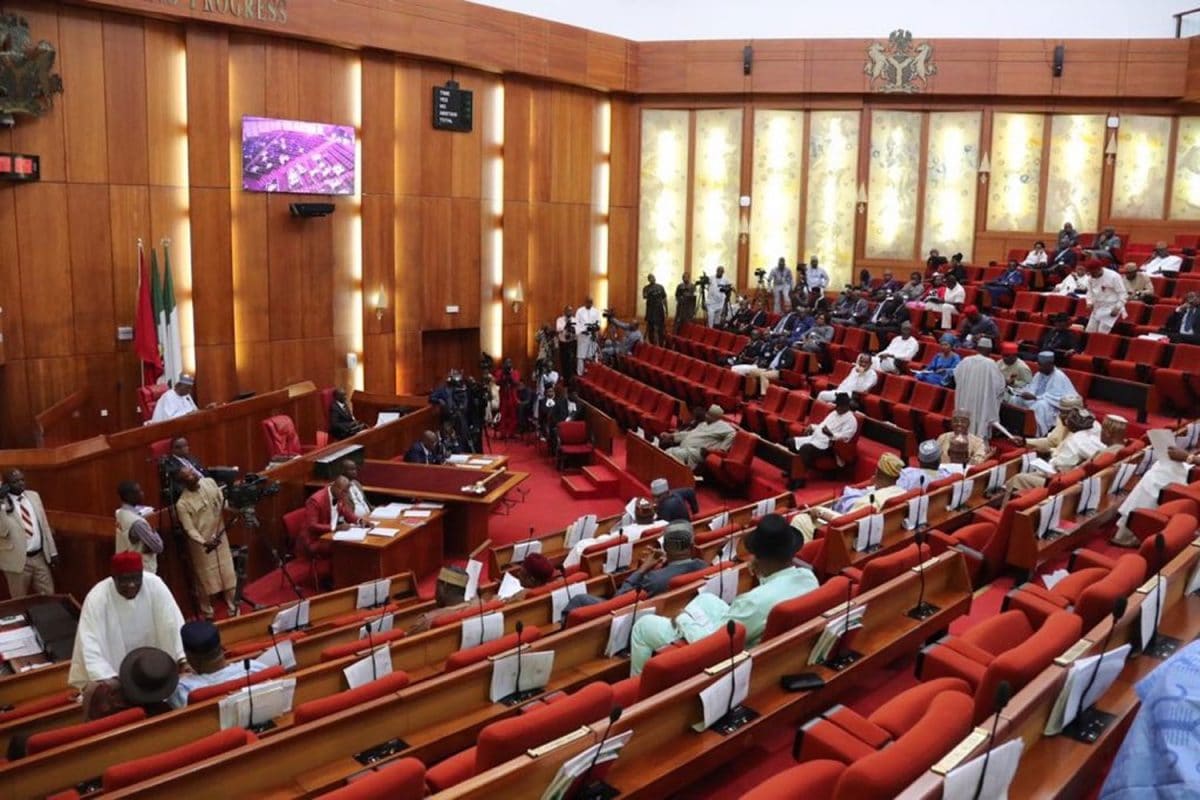
The Senate and House of Representatives yesterday moved to reset Nigeria’s failing security architecture, confirming General Christopher Musa as Defence Minister after intense scrutiny and approving far-reaching resolutions banning ransom and amnesty, tightening weapons control and demanding stricter laws to curb terrorism and mass kidnappings.
The Senate confirmed the former Chief of Defence Staff after a tense three-hour screening session marked by rare bipartisan firmness, loud protests on the floor and renewed scrutiny of Nigeria’s worsening insecurity.
The Red Chamber, which firmly rejected initial calls for the nominee to “take a bow and go”, subjected Musa to extensive questioning on defence funding, intelligence failures, technology gaps, rising banditry, terrorist infiltration and the circumstances surrounding recent military lapses and kidnappings.
The session also coincided with the Senate’s fresh move to classify kidnapping as a terrorist offence and impose the death penalty without an option of fine, in an attempt to equip the incoming minister with a harsher legal deterrent.
A mild drama unfolded when Senator Sani Musa suggested that the nominee should be asked to “take a bow and go”, arguing that most discussions on national security had previously taken place in executive sessions.
The suggestion triggered a loud uproar. “No! No! No!” many senators shouted, insisting on full interrogation.
Attempting to restore order, Senate President Godswill Akpabio rose and invoked Senate rules: “Whenever the Senate President rises, everyone must keep quiet.”
He declared, “This is not a time for bow and go. Our constituents are asking questions. Our children, brothers, and sisters are in the bush. Even Donald Trump is on our neck.”
Akpabio also raised concerns over alleged security orders directing troops to withdraw before the kidnapping of schoolchildren in Kebbi, questioning who leaked sensitive operational information involving a senior military officer.
Deputy Senate President Barau Jibrin argued that insurgency was waning until the “infamous statement” by former U.S. President Donald Trump, which he said escalated security tensions.
He commended President Bola Tinubu for stabilising areas such as Monguno. “When people talk in Nigeria, they behave as if nothing is moving,” he said.
Responding to senators’ questions, General Musa was unequivocal: “No negotiation with criminals. Nigeria must stop ransom payments, and states must not engage in deals that compromise national security.”
He added that the fight against insecurity cannot be won by the military alone.
“Good governance, justice and equity are key. Security is local. We must carry the people along. We need a comprehensive, unified national database. Only 25–30 per cent of this war is kinetic. The rest is governance,” he said.
Musa also insisted that improved technology, perimeter fencing and community cooperation could end mass kidnapping of schoolchildren. He faulted delays in terrorism and kidnapping trials, describing them as demoralising for security agencies.
On the controversial capture of a brigade commander by insurgents, Musa said, “We will not allow terrorists to build such capacity. We will investigate fully, and anyone found culpable will face the law. There must be no indolence in the Armed Forces.”
Senators Mohammed Onawo, Abdul Ningi, Ali Ndume and others pressed Musa on the military’s inability to match bandits’ superior firepower. Ningi asked bluntly: “Why are we seeing bandits with more sophisticated weapons while our officers still carry AK-47s?”
Musa responded that significant gaps still exist within the Armed Forces, particularly in technology and intelligence integration, and pledged urgent reforms.
Former Senate Leader Ali Ndume urged the minister-designate to push for the Nigerian Armed Forces to be placed on First Line Charge, like INEC, NDDC, and UBEC, so that it can receive funds directly from the Federation Account.
He argued that predictable defence funding would eliminate bureaucratic delays that cripple military operations. “Security is too important for foot-dragging. There should be no justification for delay in disbursement for procurement and operations,” Ndume said.
He also insisted that Musa prioritise improved welfare for troops, lamenting that Nigerian soldiers are not among the best paid in West Africa.
Responding to inquiries, Musa stressed that the military maintains strict vetting and would not allow former insurgents entry into the Armed Forces. He emphasised the need for a unified national database to prevent criminals from evading tracking by simply relocating.
The Defence Minister-designate listed core action points, including withdrawing soldiers from routine checkpoints and allowing police and civil defence to take over; redeploying troops to forests to hunt terrorists “in their hideouts”; stronger synergy with governors and MDAs; aggressive community engagement, as done in Maiduguri; and tackling illegal mining linked to terrorism financing.
Others are expanded maritime security operations under Operation Delta Safe; improved border surveillance up to Cameroon; protection of farmlands to ensure food security; and rigorous recruitment screening backed by digital data systems.
He vowed to return to the Senate within three weeks of assuming office for a closed-door session on defence gaps and required legislative support.
Musa acknowledged massive public expectations following his nomination. “I felt the heat when my name was announced. I cannot afford to fail myself, my nation or my family.”
He pledged a strict professional regime within the Armed Forces: “No indolence. No cowardice,” he said.
He warned that Nigeria must not allow terrorists any breathing space. “These are evil forces with no respect for human life. Nigerians must work together in unison. We will face them squarely and stop the killings.”
Akpabio disclosed that the Senate has begun the process of designating kidnapping as a terrorist act, punishable by death with no option of fine. “We are giving you the enabling framework,” he told Musa. “If they are not deterred, they will face a death sentence.”