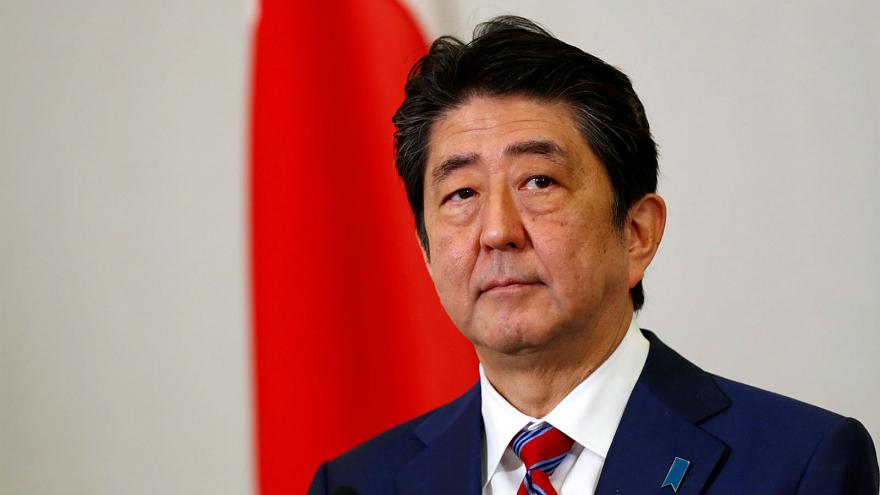
A man who admitted to killing former Japanese prime minister Shinzo Abe has been sentenced to life in prison.
Tetsuya Yamagami, 45, admitted to shooting Abe during an election campaign appearance in Nara in July 2022.
Yamagami pleaded guilty when the trial opened at Nara District Court in October, leaving little doubt about the verdict and focusing attention instead on the severity of his punishment.
Public opinion in Japan was divided between those who saw it as a calculated assassination, and others who viewed Yamagami as a deeply troubled individual.
Prosecutors described the attack as an “extremely grave incident that is unprecedented in post-war history”.
The former leader was delivering a stump speech in the western city of Nara when he was struck by shots fired from a homemade gun. Abe, who was 67, collapsed at the scene and later died. The killing stunned Japan, a country known for some of the world’s toughest gun-control laws.
Although he was no longer prime minister at the time, Abe remained one of the most influential figures in the ruling Liberal Democratic Party (LDP), which has governed Japan for most of the post-war era.
He served a total of 3,188 days in office across two terms and stepped down in September 2020 for health reasons. His death removed a dominant powerbroker from Japanese politics and contributed to instability within the party leadership.
During testimony, Yamagami said his actions were driven by anger towards the Unification Church, a South Korea–founded religious organisation that critics in Japan describe as a cult.
He told the court he decided to target Abe after seeing a video message the former prime minister sent to a group linked to the church. He said he wanted to damage the organisation and draw attention to its political connections.
The assassination prompted scrutiny of long-standing ties between the LDP and the church. An internal party investigation later found that more than 100 lawmakers had some form of contact with the group, fuelling public distrust and electoral backlash.
Yamagami was arrested at the scene and has remained in custody since the attack.
His defence lawyers sought a fixed-term sentence of no more than 20 years, pointing to his upbringing and the impact of his mother’s involvement with a religious group.
Japan retains the death penalty for murder, but it is rarely sought unless a crime involves multiple victims. In this case, prosecutors opted against capital punishment despite the high-profile nature of the killing.
Abe was shot on 8 July 2022 while addressing voters outside a busy railway station in the western city of Nara. Television footage captured two loud bangs as he raised his fist mid-speech, before collapsing.
Officials later said he died almost immediately. Yamagami was apprehended at the scene, where police recovered a crude, homemade firearm. The attack shocked a country known for its strict gun laws and low rates of violent crime.
In court, Yamagami said he targeted Abe after seeing a video message the former leader had sent to an organisation linked to the Unification Church, a South Korea–founded religious movement established in 1954 and known for mass weddings.
He told judges that his aim was not personal revenge against the politician but to damage the church, which he said he hated, and to expose its connections to prominent figures.
He also said he had originally planned to attack the church’s leader but abandoned that idea because it was too difficult to get close, switching his focus to Abe instead.