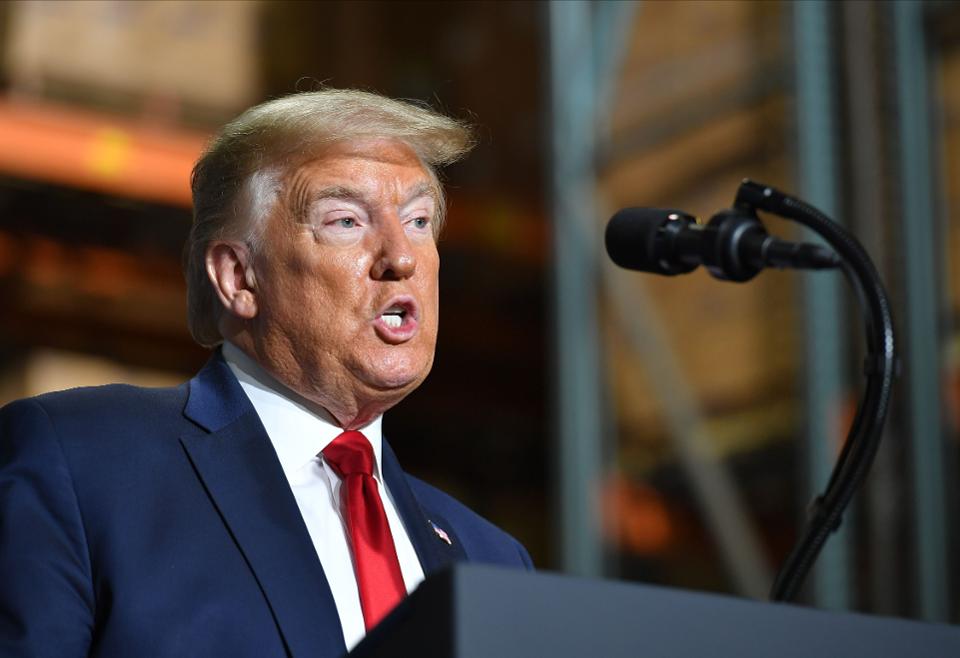
President Donald Trump is set to address a gathering of world leaders and business chiefs as tensions flare between the US and Europe over his threats to take control of Greenland.
His journey to Switzerland was delayed after his plane, Air Force One, was forced to turn round after what White House press secretary Karoline Leavitt said was “a minor electrical issue”. The plane returned safely and Trump boarded another aircraft to complete the journey.
Trump arrives for the international forum after threatening tariffs on Denmark and seven other allies, including the UK, unless they negotiate a transfer of the semi-autonomous territory.
European leaders have been largely united in criticising Trump’s plan to charge a 10% tariff “on any and all goods” sent to the US from February 1, increased to 25% from June 1, until a deal is reached for Washington to purchase Greenland from Denmark. The tariffs would apply to the UK, Denmark, Norway, Sweden, France, Germany, the Netherlands, and Finland – all of whom are members of Nato alongside the US.
The EU is considering a package of retaliatory tariffs – worth around £80 billion – targeting Boeing aircraft, Harley-Davidson motorcycles, bourbon whiskey and Levi’s jeans.
Starmer struck a more conciliatory note on Monday in a speech to the nation, saying a trade war would be in “no one’s interests” and ruled out imposing retaliatory tariffs.
No 10 said that at Tuesday’s Cabinet meeting, Starmer “reiterated that Greenland’s future was a matter for Greenlanders and the Kingdom of Denmark”, a stance echoed by European allies.
Trump has already attacked allies for refusing to back his demands to purchase Greenland, including lashing out at Keir Starmer’s government, calling the transfer of the Chagos Islands to Maurtitius and act of “great stupidity,” despite his administration’s previous endorsement of the deal.
He also posted a text message from French President Emmanuel Macron and Nato’s Secretary General Mark Rutte, as well as multiple AI-generated photos showing US ownership of Greenland and Canada.
The president in a text message that circulated among European officials this week also linked his aggressive stance on Greenland to last year’s decision not to award him the Nobel Peace Prize.
In the message, he told Norway’s prime minister, Jonas Gahr Støre, that he no longer felt “an obligation to think purely of Peace.”
All of this will be in the background as numerous European leaders and senior member of the business world meet Trump.
“This will be an interesting trip,” Trump told reporters as he departed the White House on Tuesday evening for his flight to Davos. “I have no idea what’s going to happen, but you are well represented.”
European Commission President Ursula von der Leyen warned the bloc’s response, should Trump move forward with the tariffs, “will be unflinching, united and proportional”.
She suggested that Trump’s new tariff threat could also undercut a US-EU trade framework reached this summer that the Trump administration worked hard to seal but has yet to be fully ratified.
“The European Union and the United States have agreed to a trade deal last July,” von der Leyen said in Davos. “And in politics as in business — a deal is a deal. And when friends shake hands, it must mean something.”
Trump has warned Europe against retaliatory action for the coming new tariffs.
“Anything they do with us, I’ll just meet it,” Trump said during a TV interview on Tuesday. “All I have to do is meet it, and it’s going to go ricocheting backwards.”
Before Greenland took over the trans-Atlantic debate, Trump had hoped to use the meeting in Davos to talk about making housing more affordable to regular Americans.
White House officials have promoted it as a moment for Trump to try to rekindle populist support back in the U.S., where many voters who backed him in 2024 view affordability as a major problem.
Trump is also expected to meet other leaders on the sidelines of the forum to discuss his Board of Peace, the body that is supposedly meant take the lead on keeping peace in Gaza, but has faced sustained criticism in recent days.
Fewer than ten leaders have accepted invitations to join the group so far, including a handful of leaders considered to be anti-democratic authoritarians. Several of America’s main European partners have declined or been noncommittal, including Britain, France and Germany.
It has been reported Trump plans to charge countries $1bn to be a member, which most nations have found unacceptable.
Several countries have also said Trump could use it to undermine the UN, something which he said “might” happen.