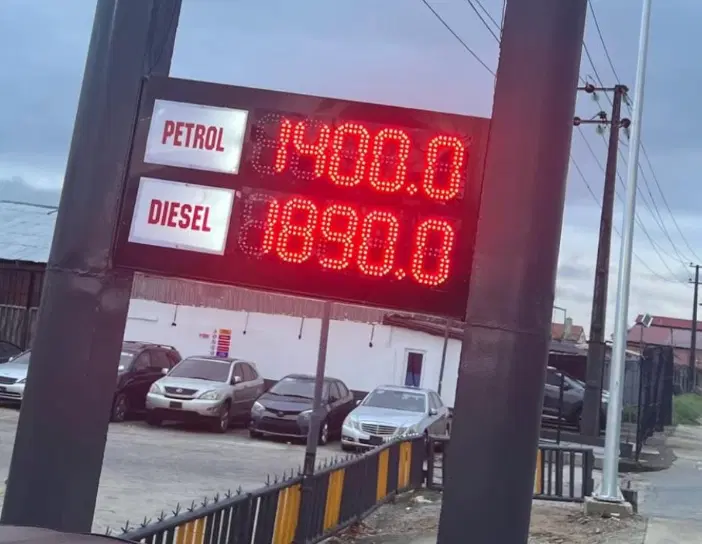
Nigerians may face another round of higher transport fares and food prices following Dangote Petroleum Refinery’s latest increase in the price of Premium Motor Spirit (PMS), popularly known as petrol.
The refinery raised its petrol gantry price from N1,265 to N1,350 per litre, effective Saturday, September 12, representing an increase of N85. The adjustment is the fourth reported upward review of its petrol price since August 21, bringing the cumulative increase to N185 in 22 days.
The development has heightened fears of fresh increases in transport fares, food prices and operating costs for businesses, coming at a time when households are still struggling with the effects of previous energy price adjustments.
The latest hike was announced amid elevated international crude oil prices, with Brent Crude trading at about $104.60 per barrel, following earlier movements above $107. The increase has been linked to supply concerns arising from the continuing conflict in the Middle East and disruptions around the Strait of Hormuz.
The adjustment has also revived questions about the sustainability of Nigeria’s post-subsidy petroleum pricing regime and whether the emergence of large-scale domestic refining can significantly reduce the impact of global oil price volatility on Nigerian consumers.
For ride-hailing operator, Peter Obasi, the latest petrol price hike has made the business increasingly difficult to sustain, with fares displayed on the inDrive platform no longer covering his operating costs.
“Indrive is not favourable to us because of the fuel price. We have to tell customers to add to the amount on the app and if the customer refuses, I have to cancel the ride because it is not favouring my business. I bought fuel at N1,400 per litre, which is crazy,” he said.
Bolanle Ajisafe, a consumer, said the latest price hike would put further pressure on household finances.
Petroleum economist, Prof. Wumi Iledare, said the justification for the latest increase could not be determined by comparing crude oil prices alone, noting that several components contribute to the final price of petrol. He said the movement in crude oil prices from $100 to $107 per barrel should be examined alongside the cost of refined products, logistics, primary margins, retail margins and distribution costs.
According to him, the relationship between crude prices and petrol prices is not necessarily one-to-one, particularly in Nigeria, where exchange rate movements and imported products continue to influence downstream costs.
Iledare explained that petrol prices could rise faster than they decline because of the way costs are transmitted through the supply chain.
He described the phenomenon as asymmetry in price transmission, saying increases in food prices could quickly affect petroleum product prices, while reductions might take longer to reflect at the pump.
The expert warned that eliminating the possibility of imported petroleum products could create a market dominated by a single supplier, giving the dominant refiner excessive influence over prices.
The Petroleum Economics and Wealth Initiative (PEWI) also argued that a situation where Nigeria exports of crude oil while Dangote imports crude is not necessarily an economic contradiction.
It, however, stressed that Nigeria must capture more value through competitive domestic refining and downstream activities without sacrificing the foreign exchange earnings generated from crude exports.
Dr Ayodele Oni, an energy economist, said the latest increase showed that the post-subsidy pricing model was operating as designed. He explained that petrol prices were now responding to changes in crude oil prices and other market fundamentals, unlike the previous arrangement in which government maintained prices through subsidy payments.
“What domestic refining changes is not the crude price, but everything around it: the import freight, demurrage, financing and forex premium Nigerians paid for decades is gone,” Oni said.
However, he warned that the latest increase would have serious consequences for households because petrol costs feed directly into transportation and food prices.
“It is serious and it is fast. Petrol feeds directly into transport, and transport into food, which dominates the average household basket,” he said.
Oni urged the Federal Government to intervene through targeted assistance rather than compelling refiners to sell below cost.
“The economically sound question is not whether the pump should ignore crude, but who should carry the cushion. The answer is the government, not the refinery,” he said.
He proposed directing additional crude oil revenues towards transport support and cash transfers for vulnerable Nigerians, with published figures to ensure accountability.
Also recommending funding Compressed Natural Gas (CNG) and Liquefied Natural Gas (LPG) conversion for commercial vehicles and mass transit fleets, he argued that the measure would permanently reduce petrol consumption.
Energy expert, Prof Dayo Ayoade, said the latest increase was consistent with the operation of a deregulated petroleum market, where international price movements influence domestic costs.
“There’s no big surprise there because when you go to a market system, the market will determine the price,” he said.
Ayoade argued that refiners could not be expected to absorb substantial losses by selling below market costs.
“You cannot expect them to take a big loss on the local market,” he said.
He, however, acknowledged that consumers were increasingly burdened by high prices and urged the government to explore measures that could reduce the impact without returning to broad petrol subsidies.
“You can subsidise transportation. You can increase CNG transportation,” he said. “The consumers are fed up with high prices, they are fed up with the cost of living, and the government has to do something.”