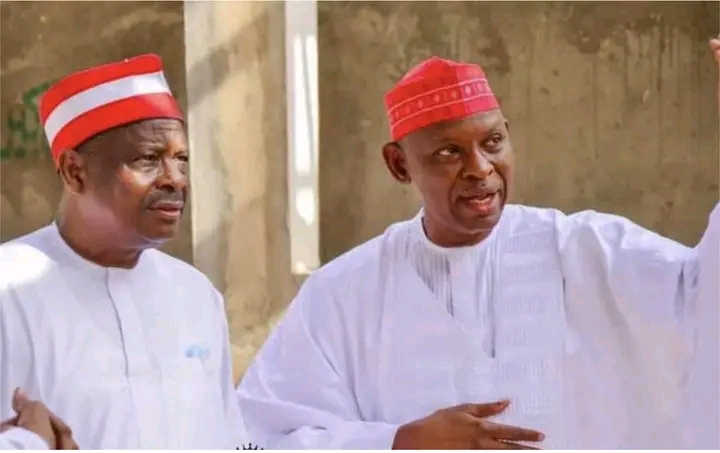
Former Kano State Governor and National Democratic Congress (NDC) chieftain, Rabiu Musa Kwankwaso, has accused his successor, Governor Abba Kabir Yusuf, of attempting to tarnish his reputation by allegedly using anti-corruption institutions, particularly the Economic and Financial Crimes Commission (EFCC), for political purposes.
Kwankwaso made the allegation in a statement published on his X account on Friday.
The former governor alleged that Yusuf was determined to drag him and members of his family into public controversy as part of an attempt to destroy the reputation he had built over nearly five decades.
Kwankwaso recalled that Yusuf had worked with him as his Personal Assistant, Principal Private Secretary and Commissioner before becoming the candidate of their political movement in the 2019 and 2023 governorship elections.
He said their relationship spanned 43 years and that he had played a significant role in Yusuf’s emergence as governor in 2023.
According to him, the trust he placed in the governor had regrettably been misused and abused.
“The longstanding relationship of 43 years with him and trust I reposed in him afforded him access to information and insight into the value I place on personal integrity, trust that has, regrettably, been misused and abused,” he said.
Kwankwaso further alleged that Yusuf had personally approached the EFCC several months ago with a formal request to investigate him but resorted to another organisation after allegedly failing to compel the commission to act against him.
He accused the governor of using the Society for Anti-Corruption and Good Governance Initiative (SACGGI) to put pressure on the anti-graft agency through protests and media activities.
The allegation comes two days after SACGGI staged a protest at the EFCC headquarters in Abuja, demanding an investigation into Kwankwaso over alleged ownership of several high-value properties in Abuja, Lagos, Kano and Nasarawa states.
The organisation also submitted a petition asking the commission to investigate the sources of funds used to acquire the properties, as well as the former governor’s bank accounts, tax records and asset declarations.
During the protest, SACGGI spokesperson, Muhammad Abdullahi, said the organisation wanted the EFCC to establish the actual ownership of the properties, determine their sources of funding and ascertain whether they were properly declared in accordance with public service regulations.
The group maintained that its petition was not politically motivated and insisted that public office holders should be accountable for their wealth.
Responding to the protesters, Michael Nzekwe, Chief of Staff to the EFCC Chairman, assured them that the commission would examine the petition professionally, stressing that the agency was apolitical.
However, Kwankwaso questioned the credibility of SACGGI, alleging that the organisation was neither registered with the Corporate Affairs Commission (CAC) nor had any verifiable digital presence or formal relationship with the EFCC or the Independent Corrupt Practices and Other Related Offences Commission (ICPC).
He said the organisation was used to organise protests at the EFCC headquarters in what he described as a deliberate attempt to pressure the commission into taking action against him.
“We believe that some months ago the Governor personally submitted a formal request to the EFCC seeking to come after me. After failing to compel the Commission, owing to its institutional integrity and established procedures, he resorted to a little-known body called the Society for Anti-Corruption and Good Governance Initiative (SACGGI),” Kwankwaso stated.
He also accused the Kano State governor and some members of his cabinet of using the media to promote allegations against him through what he described as selective leaks of information.
According to Kwankwaso, the alleged campaign was aimed at damaging his public image and weakening his political camp ahead of the 2027 general elections.
He warned that the development could further heighten political tension in Kano State and threaten the prevailing peace and security in the state.
The former governor also claimed that the alleged political campaign extended beyond him to other members of his political camp, particularly the Kano State governorship candidate, Aminu Abdussalam.
He alleged that Yusuf was attempting to influence institutions, including the Independent National Electoral Commission (INEC) and the judiciary, to prevent Abdussalam’s name from appearing on the ballot for the 2027 governorship election.
Kwankwaso said Abdussalam was currently defending his governorship ticket before INEC and the courts, alleging that the ultimate objective was to prevent him from contesting and allow Yusuf to emerge as the sole candidate.
The former governor, however, commended the EFCC for what he described as its professional handling of previous invitations extended to him during his years in public service.
He maintained that he had no record of corruption despite holding several public offices throughout his career.
Kwankwaso listed his previous positions to include two terms as governor of Kano State, 17 years in the civil service, Deputy Speaker of the House of Representatives during the aborted Third Republic, Minister of Defence, Special Adviser to the President on Darfur and Senator representing the Northwest in the 8th National Assembly.
He also recalled serving as an elected delegate to the 1994–1995 Constitutional Conference and as a member representing the Northwest on the Niger Delta Development Commission.
“I thank God that more than eleven years after leaving the Kano State Government, having served two full terms as Governor spanning eight years, in addition to seventeen years in the civil service, service as Deputy Speaker of the House of Representatives during the aborted Third Republic, as an elected delegate to the 1994–1995 Constitutional Conference, as Minister of Defence, as Special Adviser to the President on Darfur, as a member representing the Northwest on the Niger Delta Development Commission, and as a member of the 8th Senate, I have maintained a clean record,” he said.
He also used the opportunity to caution serving and younger politicians against engaging in actions that could expose them to public scrutiny, reminding them that political power was temporary.
“Public office is transient; those who live in glass houses should be careful about throwing stones,” he added.