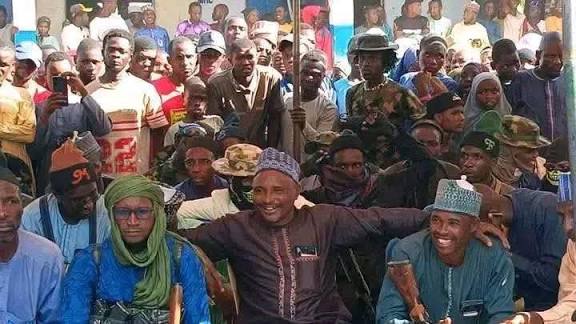
Northern leaders have disagreed with the federal and state governments over amnesty being granted to terrorists who have turned the region into a killing field.
The leaders’ angst is coming against the backdrop of plans by Katsina State governor, Dikko Radda, to grant amnesty to 70 terrorists, as part of an agreement reached between the state government and terrorists terrorising the state and other parts of the north.
The anger of the northern leaders was accentuated by the position of the Office of the Attorney-General of the Federation, AGF, on the matter, as Special Adviser to the President (Communications and Publicity) in the AGF’s office, Mr Kamarudeen Ogundele, yesterday gave vent to governors’ powers to grant such a pardon.
”Governors have constitutional powers to grant pardon, if the terrorists were prosecuted by their respective states,” Ogundele said in a terse reaction sent to Vanguard yesterday.
The AGF’s position was corroborated by the Attorney-General and Commissioner for Justice in Lagos State, Lawal Pedro, SAN, who reiterated that governors had powers to grant such pardon but noted that in exercising the power, they (governors) should consider public opinion, public policy and how people would feel.
He said: ”Clemency is a constitutional power granted to governors, and it has no limitation or restriction with respect to offences, whether it’s terrorism, murder or any offence whatsoever.
”But in the exercise of that power, the governor is expected to consider public opinion and public policy and how the people will feel.
”He can exercise that power at his discretion based on that consideration. For instance, in Lagos, our policy on clemency is that we don’t consider pardon for people convicted of sexual offences.
”There is nothing in the law that stops us from granting them amnesty, but because of the prevalence of sexual offences, our policy is not to grant convicted sexual offenders clemency so as not to encourage other offenders.
”In the case of terrorism, too, I will expect governors not to grant amnesty to convicted terrorists so that I will not send the wrong signal.”
However, senior legal practitioners in the country described the granting of amnesty to terrorists by state governors as an anomaly.
In separate interviews with Vanguard, the lawyers maintained that no portion of the 1999 Constitution, as amended, conferred such powers on governors.
They were unanimous in their stance that terrorism, being a federal offence, fell outside the scope of powers of state governors.
Senior Advocate of Nigeria, SAN, Mr. Kunle Edun, said: “Terrorism is a federal crime under the Terrorism (Prevention & Prohibition) Act, 2022, which is a federal legislation passed by the National Assembly.
“State governments lack the power to grant amnesty, pardon or any form of reprieve to any person arrested, charged, prosecuted or convicted for any offence relating to terrorism, particularly if the person was prosecuted pursuant to the Terrorism Prevention & Prohibition Act.
“The Federal Government, through appropriate federal security agencies, has powers to take over such matter and the suspects from the state government and deal with it as a federal crime.”
Another SAN, Mr. Dayo Akinlaja, said: “Terrorism is a federal offence triable at the Federal High Court. A governor can only grant pardon or amnesty to a person in respect of an offence created by a law of the state.”
Mr. Akinlaja’s position was affirmed by another lawyer, Olugbenga Ephraim, who noted that though governors could pardon offenders, such exercise of power was limited to only state offences.
“It is a constitutional anathema for anyone to contemplate that a state governor has the powers to grant amnesty to terrorists.
“There is no doubt that governors hold powers of prerogative of mercy under section 212 (1) of the 1999 Constitution, as amended. The section allows them to pardon, respite, substitute punishment, or remit penalties.
“However, such powers are only applicable to offences that are created by state laws. A governor cannot grant amnesty to terrorists.
“Terrorism is a federal offence that is governed by federal laws, such as the Terrorism (Prevention) Act. Therefore, the prosecution of suspected insurgents or bandits squarely falls within the remit of the Federal Government, not states.”
On his part, Nasiru Suleiman, an Abuja-based lawyer, argued that governors could pardon suspected terrorists who have not been charged to court.
“There is no portion of the 1999 Constitution that allows any governor to pardon convicted terrorists.
However, if the suspected terrorists have not been charged to court, a governor, as the chief security officer of his state, can deploy any legal means to tackle all forms of insecurity within his territory. This may include the carrot and stick approach.
“But once it concerns a terrorism charge or conviction, no governor or Attorney-General of a state can intervene in such a case, let alone grant amnesty to anyone,” he argued.
The Lagos Attorney-General and lawyers’ position on the issue tallied with that of the Northern leaders of thought and their elite political, religious and tribal organizations who described the activities of terrorists in the region as inimical to its development.
Among those who spoke to our correspondents on the matter, were leaders of Arewa Consultative Forum, ACF; Middle Belt Forum, MBF; Coalition of Northern Groups, CNG; Christian Association of Nigeria, CAN; Northern States Christian Elders Forum: Nomadic Rights Concern, NORIC; and some Islamic scholars and leaders in the Northern region.
While most of those interviewed vehemently opposed the idea of granting amnesty to terrorists as a condition for peace, others, such as NORIC, said the idea was good and should be pursued if only that would guarantee peace and security in the land.