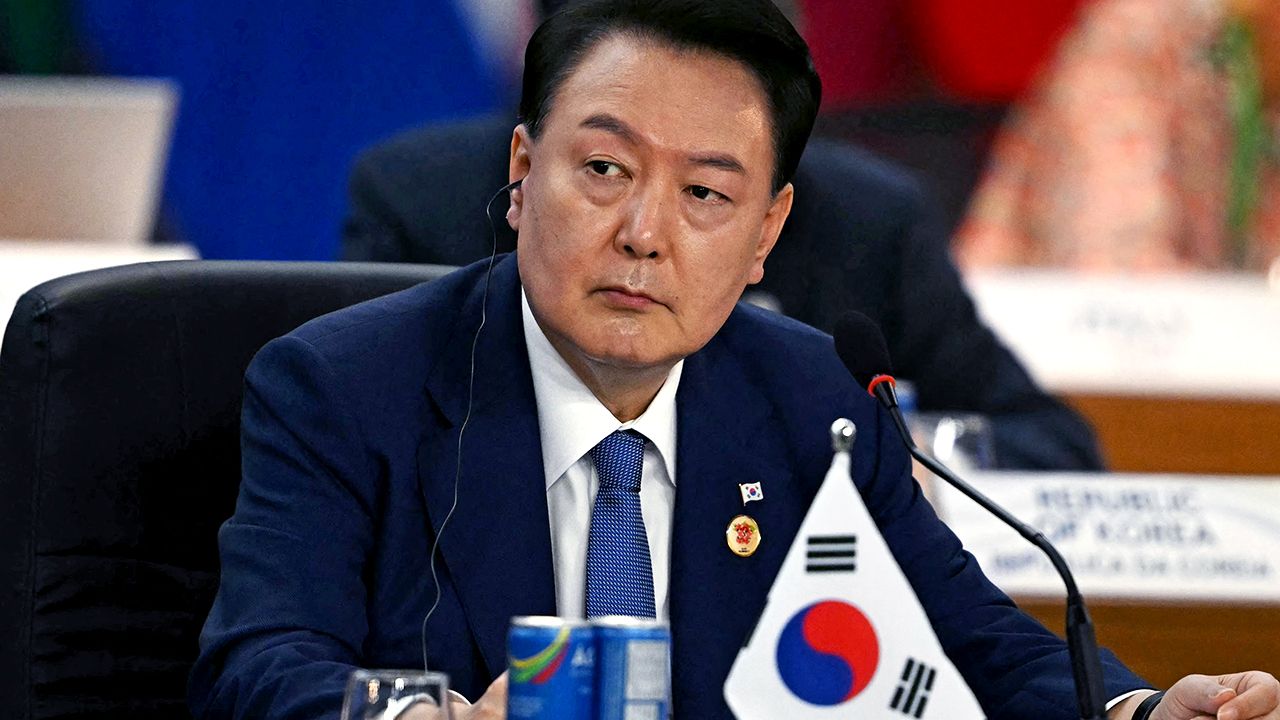
The former president of South Korea has been sentenced to five years in prison in the first verdict from eight criminal trials relating to his ill-fated martial law decree, which ended up in him being forced out of office.
President Yoon Suk Yeol was impeached, arrested and dismissed as president after his short-lived imposition of martial law in December 2024 triggered huge public protests calling for his ouster.
The most significant criminal charge against him alleges that his martial law enforcement amounted to a rebellion, for which he could face the death penalty, with the verdict due next month.
Yoon has maintained he didn’t intend to place the country under military rule for an extended period, saying his decree was only meant to inform the people about the danger of the liberal-controlled parliament obstructing his agenda.
But investigators have viewed Yoon’s decree as an attempt to bolster and prolong his rule, charging him with rebellion, abuse of power and other criminal offences.
In Friday’s case, the Seoul Central District Court sentenced Yoon for defying attempts to detain him, fabricating the martial law proclamation, and sidestepping a legally mandated full Cabinet meeting and thus depriving some Cabinet members who were not convened of their due rights to deliberate on his decree.
Judge Baek Dae-hyun said in the televised ruling that imposing “a grave punishment” was necessary because Yoon hasn’t shown remorse and has only repeated “hard-to-comprehend excuses.”
Yoon’s defence team said they will appeal the ruling, which they believe was “politicised” and reflected “the unliberal arguments by the independent counsel.”
Yoon’s defence team argued the ruling “oversimplified the boundary between the exercise of the president’s constitutional powers and criminal liability.”
On the night of December 3, 2024, Yoon abruptly declared martial law in a televised speech, saying he would eliminate “anti-state forces” and protect “the constitutional democratic order.”
Yoon sent troops and police officers to encircle the National Assembly, but many apparently didn’t aggressively cordon off the area, allowing enough lawmakers to get into the assembly hall to vote down Yoon’s decree.
No major violence occurred, but Yoon’s stunt caused the biggest political crisis in South Korea and rattled its diplomacy and financial markets.
After Yoon’s ousting, his liberal rival Lee Jae Myung became president via a snap election last June. After taking office, Lee appointed three independent counsels to look into allegations involving Yoon, his wife and associates.
Yoon’s other trials deal with charges like ordering drone flights over North Korea to deliberately inflame animosities and look for a pretext to declare martial law.
Other charges accuse Yoon of manipulating the investigation into a marine’s drowning in 2023 and receiving free opinion surveys from an election broker in return for a political favour.
Prison sentences in the multiple, smaller trials Yoon faces would only matter if he is spared the death penalty or life imprisonment at the rebellion trial.
It is seen as unlikely that Yoon will be given the death sentence, as South Korea has maintained a de facto moratorium on executions since 1997 and courts rarely hand down death sentences.
For many, Yoon’s attempt at declaring martial law, the first of its kind in more than four decades in South Korea, brought back harrowing memories of past dictatorships in the 1970s and 1980s, when military-backed leaders used martial law and emergency measures to deploy soldiers and tanks on the streets to suppress demonstrations.
South Korea has a history of pardoning former presidents who were jailed over diverse crimes in the name of promoting national unity.
Yoon is likely hoping this will happen to him in the future.
Those pardoned include strongman Chun Doo-hwan, who received the death penalty at a district court over his 1979 coup, the bloody 1980 crackdowns of pro-democracy protests that killed about 200 people, and other crimes.