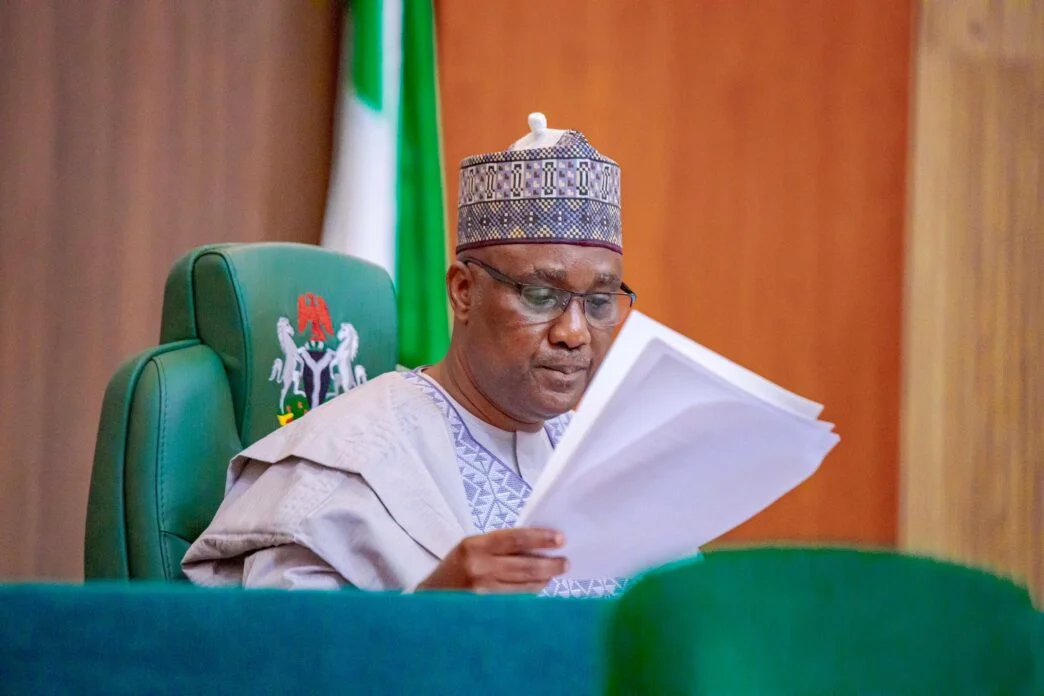
The House of Representatives yesterday passed President Bola Tinubu’s N58.4 trillion 2026 appropriation bill through second reading without debate, a move that could raise questions over whether legislative oversight is giving way to executive dominance ahead of 2027.
The plenary was presided over by Speaker Tajudeen Abbas.
The bill, christened the ‘Budget of Consolidation, Renewed Resilience and Shared Prosperity,’ was presented by President Bola Tinubu to a joint session of the National Assembly in December. It seeks authorisation to withdraw N58.4 trillion from the Consolidated Revenue Fund of the Federation for the 2026 fiscal year.
Despite the scale of the proposal, lawmakers did not debate the general principles of the bill after an earlier closed-door meeting that lasted nearly an hour.
Only the Leader of the House, Prof Julius Ihonvbere, spoke.
He highlighted government achievements in economic management, saying the economy grew by 3.98 per cent before the budget presentation, while inflation had declined and foreign investments and exports expanded.
Ihonvbere said the budget was designed to consolidate macroeconomic stability, improve revenue performance, strengthen human capital development and manage existing debts. He added that the government had not printed “a single naira” since taking office, a move he said contributed to economic stability, while external reserves had reached a seven-year high of $47 billion.
Urging lawmakers to support the proposal, he described the budget as an opportunity for the legislature to partner with the executive in achieving sustainable development and shared prosperity.
“I believe that this administration is committed to ensuring that if we all work together, put ideas together, recommit to a better Nigeria, we build a kind of social, political, economic environment that will ensure Nigerians in their respective constituencies and communities reach the highest points of their creative and productive abilities.
“When we are able to do this, Nigeria will be a better place, not just for us, but for generations to come. It will also encourage those that will come into power, well into the future, to build on the achievements of the present government and prioritise the welfare, women and children.”
After his remarks, the Speaker invited contributions from the floor, but none followed. He then put the motion to a voice vote, with the ayes prevailing.
The bill was subsequently referred to the Appropriation Committee, while the House adjourned for two weeks to allow relevant committees to carry out detailed work on the budget.
Senate sets up seven-member committee to harmonise Electoral Act amendments
Meanwhile, the Senate has constituted a seven-member ad hoc committee to harmonise and streamline lawmakers’ contributions to the proposed amendment of the Electoral Act.
The decision followed a three-hour closed-door executive session held yesterday, during which senators conducted a deeper review of the far-reaching electoral reforms.
Announcing the outcome of the session, Senate President Godswill Akpabio said the committee was mandated to “contribute, galvanise and distil the opinions of senators on the bill.”
The committee, to be chaired by Senator Niyi Adegbonmire, Chairman of the Senate Committee on Judiciary, Human Rights and Legal Matters, also includes Senators Adamu Aliero, Aminu Tambuwal, Adams Oshiomhole, Danjuma Goje, Tony Nwoye and Titus Zam.
Akpabio said the panel has a maximum of three days to complete its assignment and report back to the Senate by Tuesday.
The Senate had earlier, on Wednesday, stepped down consideration of the report on the Electoral Act, 2022 (Repeal and Enactment) Bill to allow for an executive session and more rigorous scrutiny of the proposed amendments.
The decision followed plenary deliberations on the report of the Senate Committee on Electoral Matters, which was presented in the absence of its chairman, Senator Simon Lalong.
Lawmakers agreed that further debate should be deferred to give senators adequate time to study the bill, citing its significant implications for Nigeria’s electoral process.
Although the House of Representatives has already passed the bill, Mr Akpabio stressed that the Senate must exercise due diligence.
“This is a very important bill, especially as we approach another election cycle. We must take our time to ensure justice is done to all, so that we do not end up at the tribunal,” he said.
According to the committee’s report, a clause-by-clause review indicates that the bill would strengthen electoral integrity, enhance transparency and boost public confidence in the electoral system.
The committee recommended the passage of the Electoral Act (Repeal and Enactment) Bill, 2025, as amended, noting that the reforms would expand voter participation, curb electoral malpractice and strengthen the institutional capacity of the Independent National Electoral Commission (INEC).
Earlier, Senate Leader Opeyemi Bamidele outlined key highlights of the proposed amendments, saying the review would significantly improve electoral credibility and institutional independence.
He said the bill introduces stiffer sanctions for electoral offences such as vote-buying, including fines of up to N5 million, a two-year jail term and a 10-year ban from contesting elections.
The proposed law also prescribes tougher penalties for result falsification and obstruction of election officials, mandates electronic transmission of polling unit results, and introduces electronically generated voter identification, including a downloadable voter card embedded with a unique QR code.
Bamidele added that the bill recognises the voting rights of prisoners, mandates INEC to register eligible inmates, standardises delegates for indirect party primaries, and requires the release of election funds at least one year before polling day.
According to him, the reforms are aimed at guaranteeing credible, transparent and secure elections beginning with the 2027 general elections, subject to approval by at least two-thirds of state Houses of Assembly in line with constitutional provisions.
“At the end of it all, good governance, enhanced security and the welfare of our constituents shall remain our cardinal objectives,” Bamidele said.