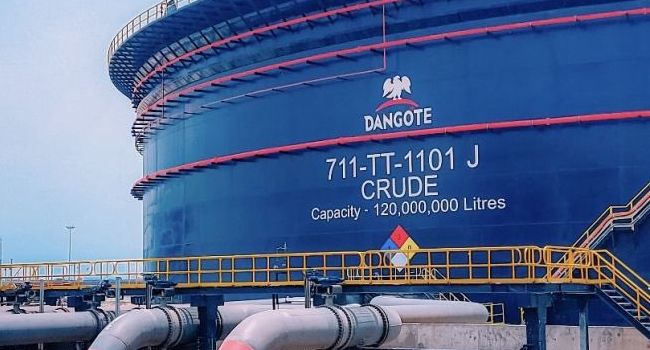
The trade dispute between the Petroleum and Natural Gas Senior Staff Association of Nigeria (PENGASSAN) and Dangote Petroleum Refinery has put Nigeria’s ambition of becoming Africa’s refining hub to the sternest test.
This comes just as the shutdown of the refinery may plunge the country into a N14.7 billion daily loss, triggering force majeure with a possible failure to meet supply contracts and the return of fuel scarcity across the country.
The development, which may spiral across the oil and gas sector, could push the Nigerian economy’s daily revenue loss into about $110.8 million from crude oil export and cause shutdown of gas power plants – a situation which may ground the already distressed economy.
Already, gas providers reported yesterday that the gas facilities supplying the Escravos Lagos Pipeline System had been shut down, resulting in the disruption of gas supply to the distribution network. Operators and customers were informed that gas would be suspended temporarily till the crisis is addressed.
Stakeholders warned that the country faces renewed foreign exchange (FX) pressures, as PENGASSAN directs its members nationwide to withdraw their services following the alleged mass dismissal of more than 800 Nigerian workers by Dangote Refinery.
In a reaction, members of the organised labour sector have called for the reinstatement of the 800 sacked workers, alleging that Dangote’s action posed a multi-dimensional danger to the country. He was accused of displacing qualified Nigerian professionals and replacing them with foreign labour.
This is just as the Petroleum and Natural Gas Senior Staff Association of Nigeria (PENGASSAN) shut down the Dangote Refinery and fertiliser plants yesterday morning. The move followed a directive by the association to its members nationwide to withdraw all services effective 12:01 am today.
It equally directed its members working across field locations, including control room operations, panel operations, and outfield personnel, to withdraw services effective 06 hours yesterday to commence 24-hour prayers.
At an emergency National Executive Council (NEC) meeting of all its branches, on Saturday, the association said Dangote Refinery’s unilateral action to sack over 800 workers for joining PENGASSAN was an affront to all workers in Nigeria and a deliberate violation of Nigeria’s labour laws, the Federal Government’s Constitution and the International Labour Organisation (ILO) Convention.
The 800 sacked workers, according to PENGASSAN, were sacked barely 24 hours after declaring their interest in joining the union.
PENGASSAN General Secretary, Lumumba Okugbawa, in a statement, said Dangote Refinery had become notorious for “enslaving Nigerian workers,” and that the eventual sack of Nigerians and hiring of 2,000 Indians showed “disloyalty to a country that has given him the most incentives any company has ever enjoyed at taxpayers’ expense.”
According to PENGASSAN, Nigerian workers at the refinery had been subjected to the worst type of working conditions in the oil and gas industry.
To this end, the association resolved that all processes involving gas and crude supply to Dangote Refinery should cease immediately. It equally urged international oil company (IOC) branches to ramp down gas production and supply to the refinery and petrochemicals arm.
Dangote, however, warned that cutting crude oil and gas supplies to the refinery could plunge Nigerians into fresh rounds of fuel scarcity while inflicting huge revenue losses on the government.
In a statement, the refinery described the directive as “criminal, reckless and an act of economic sabotage” that, if enforced, would disrupt the production and nationwide supply of critical petroleum products, including petrol, diesel, aviation fuel, kerosene and cooking gas.
The company stressed that the products are indispensable to daily life and the economy, warning that Nigerians at every level, from households to businesses and industries, would bear the brunt of shortages. It noted that a sudden disruption in supply will translate into insufferable hardship for millions of Nigerians.
In a position statement, Dangote has accused the association of deploying “bully”, “terror” and “guerrilla” tactics to force investors to submit.
Dangote recalled that in 2007, when the Federal Government sold its moribund Port Harcourt and Kaduna refineries to Blue Star Consortium, led by the Dangote Group, for $750 million, it was PENGASSAN and its ally, the Nigeria Union of Petroleum and Natural Gas Workers (NUPENG), that sabotaged the deal.
“It is now obvious to everyone that the FGN’s decision at the time was the right one and that PENGASSAN and NUPENG ignominiously wrote their names on the wrong pages of history,” the company said.
The refinery also faulted the union’s role in the much-publicised rehabilitation of the Port Harcourt Refinery, describing it as a “ruse” which PENGASSAN “knowingly celebrated despite being a scam on Nigerians.” The statement further accused the union of opposing amendments to the Petroleum Industry Act (PIA) that would have freed up federal liquidity and attracted private-sector funding into Nigeria’s upstream oil ventures.
Beyond policy obstruction, Dangote Refinery accused the association of mismanaging billions of naira in annual check-off dues to bankroll the “lavish lifestyles” of its leaders, without accountability to members. By contrast, the refinery highlighted its own record of economic contributions within a short period, citing road construction, worker training, the creation of thousands of Nigerian jobs, and a compensation structure that “outdistances the best in the Nigerian oil and gas industry.”
Stakeholders across the sector have been divided as some blamed Dangote Group, especially for breaking an agreement earlier brokered by the government, while others insisted that unionism must not be allowed to hold the entire country to ransom.
They stressed that both parties are only after their interests at the detriment of the ordinary citizens.
PENGASSAN has equally come under fire in the course of the dispute for what many described as economic sabotage, with many questioning the legality of their activities.
Last month, Nigeria’s oil production stood at 1.63 million barrels per day. If sold at the prevailing average price of $68 per barrel, Nigeria will be losing about $110.8 million a day at a time when the Federal Government is struggling to meet its revenue target as contained in the 2025 budget.
At the domestic level, an estimated average of 17 million litres of fuel has been supplied into the Nigerian market from Dangote Refinery, according to July data submitted by the Nigerian Midstream Downstream Petroleum Regulatory Authority (NMDPRA) to the Federal Account Allocation Committee (FAAC).
Cutting off that supply is enough to spark a 32 per cent shortage and increase inflation due to the direct impacts of premium motor spirit on the prices of food items, as well as goods and services.