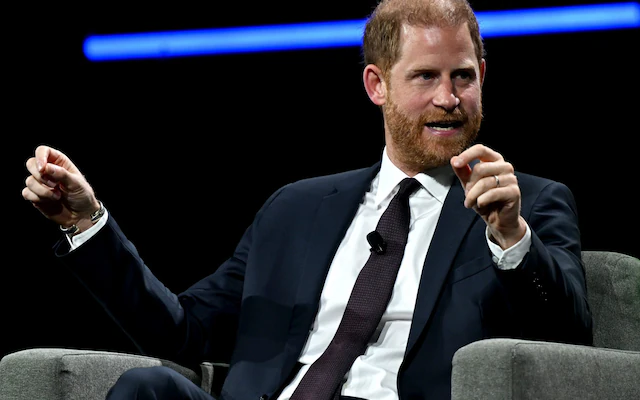
The Duke of Sussex has voiced his profound concern over a “deeply troubling” surge in antisemitism across the UK, penning an opinion piece to highlight the issue.
Writing in The New Statesman, Prince Harry emphasised the importance of “legitimate protest” but stated he felt compelled to speak out, believing that remaining silent allows “hate and extremism to flourish unchecked”.
He cited recent “lethal violence” targeting the Jewish community in Manchester and London, asserting that “hatred directed at people for who they are, or what they believe, is not protest. It is prejudice.”
Harry also acknowledged the “deep and justified alarm” regarding the extensive loss of life in Gaza and Lebanon, yet urged individuals to be more “clear” about the true target of their anger.
The duke wrote: “We have seen how legitimate protest against state actions in the Middle East does exist alongside hostility toward Jewish communities at home – just as we have also seen how criticism of those actions can be too easily dismissed or mischaracterised.
“Nothing, whether criticism of a government or the reality of violence and destruction, can ever justify hostility toward an entire people or faith.”
He said he had learned from his own “past mistakes”.
“I am acutely aware of my own past mistakes — thoughtless actions for which I have apologised, taken responsibility and learnt from. That experience informs my conviction that clarity matters now more than ever, at a time when confusion and the distortion of truth are doing real harm — even when speaking plainly is not without consequence. It requires responsibility from all of us.”
In January 2005, at the age of 20, Harry was photographed wearing a Nazi uniform to a party.
The piece is critical of the lack of nuance in much of the media discourse in the wake of the recent spate of antisemitic attacks in the UK.
The duke bemoans how polarised public debate has become, and said it deepens the confusion that “fuels division”.
Harry acknowledged that the instinct to speak out, march and call for an end to suffering was “human and necessary” but that people must be clear that the “onus falls squarely on the state – not an entire people”.
While he references the actions of “the state” throughout, he at no point names Israel during the New Statesman piece.
Harry wrote: “We cannot ignore a difficult truth: when states act without accountability, and in ways that raise serious questions under international humanitarian law – criticism is both legitimate, necessary and essential in any democracy.
“The consequences do not remain contained within borders. They reverberate outward, shaping perception, inflaming tensions.”
During an investiture ceremony on Wednesday, the daughter of Holocaust survivors said the Prince of Wales told her it is important to “preserve the truth” as she was made an OBE.
Speaking to the Press Association following the ceremony, Dr Bea Lewkowicz said William “pointed out that, especially now, it is important to, kind of, preserve the truth, because we live in this era of digital media” with “Holocaust distortion and rising antisemitism”.
Harry concluded his piece with an appeal for “unity” and a call for people to stand against antisemitism and anti-Muslim hate “wherever it appears”.
“When anger is turned towards communities – whether Jewish, Muslim, or any other – it ceases to be a call for justice and becomes something far more corrosive,” he wrote.