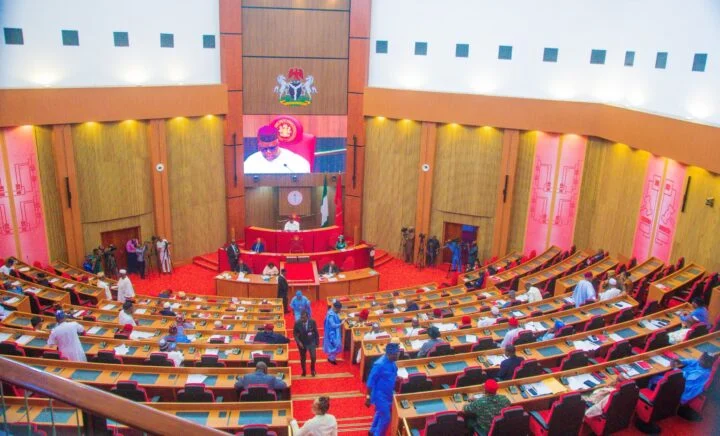
Nigeria’s electoral reform efforts stalled again yesterday as the Senate emerged from a four-hour closed session on the Electoral Act Amendment Bill without a decision, raising concerns that politically sensitive transparency measures are being delayed as the country edges closer to future polls.
Lawmakers entered executive session at about 1:06 p.m. after Senate Leader Opeyemi Bamidele moved a motion to resume the deferred clause-by-clause consideration of the report of the Senate Committee on Electoral Matters, chaired by Simon Lalong. The session lasted more than four hours, with plenary reconvening at about 5:30 p.m.
However, the chamber offered no clarity on the bill.
Addressing lawmakers, Senate President Godswill Akpabio said members had deliberated on issues “concerning the Senate in particular and the nation in general”, before asking the chamber to affirm that the outcome reflected the work of the Committee of the Whole. Members agreed, and the matter was closed without any public disclosure.
Moments later, Bamidele moved a motion to adjourn plenary to today, which was adopted.
It was the second time the Senate concluded deliberations on the Electoral Act Amendment Bill without making its position known, despite growing public interest in the legislation.
The bill contains wide-ranging proposals aimed at strengthening Nigeria’s electoral process, including mandatory real-time electronic transmission of results from polling units to the Independent National Electoral Commission Result Viewing Portal (IREV), tougher penalties for electoral offences such as result falsification and ballot box snatching, and stricter accountability measures for presiding officers.
It also seeks to replace references to the “smart card reader” with the Bimodal Voter Accreditation System (BVAS), bar party agents or candidates from accompanying visually impaired or incapacitated voters into voting cubicles, and raise fines for buying or selling Permanent Voter Cards from N500,000 to N5 million.
Despite the breadth of the proposed reforms, the Senate’s continued silence has left observers questioning when the amendments will be concluded, as the clock ticks toward future electoral contests.
Meanwhile, the National Conscience Platform (NCP) has warned that Nigeria is approaching a critical democratic crossroads, saying prolonged delays in electoral reform are deepening public distrust, suppressing participation and threatening the foundations of multiparty democracy.
In a statement jointly signed yesterday by the platform’s interim coordinators, Comrade Babatunde Agunbiade and Wale Ogunade, the group said declining voter turnout and stalled amendments to the Electoral Act point to a “systemic failure that can no longer be managed with cosmetic fixes”.
Citing figures from the Independent National Electoral Commission (INEC), the platform said voter turnout fell from about 54 per cent in 2011 to 35 per cent in 2019, before dropping further to approximately 27 per cent in the 2023 general elections. It described the trend as evidence of “public resignation rather than apathy”.
“When citizens withdraw from elections, democracy does not simply weaken; it begins to lose legitimacy,” the statement said.
The group noted that Nigeria now operates one of the most expensive electoral systems in Africa, yet public confidence continues to slide. Despite repeated investments in technology, logistics and security, elections are still widely perceived as failing to reflect the will of the people.
“This contradiction exposes the deeper problem,” the platform said. “Credibility cannot be purchased. It is built through strong institutions, fair competition and enforceable rules.”
The NCP expressed concern over what it called the prolonged stalling of key Electoral Act amendments at the National Assembly, warning that legislative inaction carries national consequences.
“Delaying electoral reform is a political decision with national consequences,” it said, adding that failure to update the legal framework sustains structural weaknesses that favour exclusion, weaken opposition politics and erode accountability.
The platform anchored its advocacy on the 2008 electoral reform report led by Mohammed Uwais, describing it as the most comprehensive blueprint yet produced for Nigeria’s electoral renewal. More than 16 years after its submission, it said many core recommendations — including proposals to strengthen the independence of the electoral management body, regulate campaign finance and deepen internal party democracy — remain largely unimplemented.
Referencing surveys by Afrobarometer, the group said fewer than one in three Nigerians believe elections genuinely reflect voters’ choices, warning that continued neglect of reform could further destabilise the polity.
Beyond elections, the NCP linked democratic fragility to broader national challenges such as insecurity, poverty and declining trust in public institutions, noting that international development partners have repeatedly identified weak governance legitimacy as a factor undermining social stability.
The platform also cautioned against any drift towards de facto one-party dominance, stressing that political pluralism is a constitutional requirement, not a concession.
“A democracy without competition cannot self-correct,” the statement said. “History shows that when political space narrows, instability expands.”
Calling for what it described as a “national duty of conscience”, the NCP urged civil society organisations, labour unions, professional bodies, youth movements, faith leaders and the media to jointly press for comprehensive electoral reform.
“Electoral reform delayed is democracy denied,” the statement concluded.