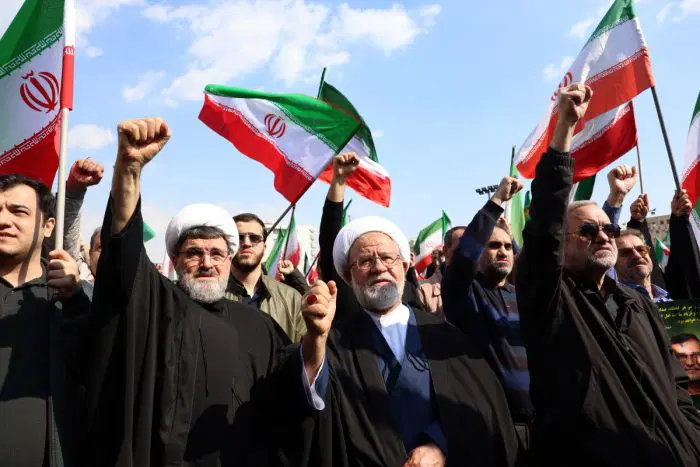
The US and Iran each warned they were ready for war as the clock ticked down Tuesday on a ceasefire, with uncertainty on talks that US President Donald Trump had announced would resume in Pakistan.
The White House said US Vice President JD Vance was ready to fly back to the Pakistani capital Islamabad, which was preparing for a second round of talks on ending the war that has engulfed the Middle East and shaken global markets.
But Tehran’s cleric-run government declined to confirm that it would participate and accused the United States of violating the truce through its blockade of Iranian ports and seizure of a ship.
“By imposing a blockade and violating the ceasefire, Trump wants to turn this negotiating table into a surrender table or justify renewed hostilities, as he sees fit,” said Iran’s powerful parliament speaker Mohammad Bagher Ghalibaf, who headed the delegations to talks two weeks ago in Pakistan.
“We do not accept negotiations under the shadow of threats, and in the last two weeks we have been preparing to show new cards on the battlefield,” he wrote on X.
Iran’s Revolutionary Guards warned of targeting any vessel attempting to pass through the Strait of Hormuz without permission.
Trump has similarly accused Tehran of violating the truce by harassing vessels in the key strait, the transit passage for about a fifth of the world’s oil that Iran had all but shut in retaliation for the war launched Feb. 28 by the US and Israel.
The channel in peacetime sees around 120 daily transits, according to Lloyd’s List, a shipping industry intelligence site.
On Tuesday, the site reported that more than 20 Iranian so-called “shadow vessels,” had transited past the US blockade.
In one of a series of posts on his Truth Social platform, Trump insisted that the blockade was “absolutely destroying” Iran and said it will not end “until there is a ‘DEAL,'” in which the United States is pressing for Iranian concessions on its contested nuclear program.
Trump told PBS News that Iran was “supposed to be there” at the talks in Pakistan.
“We agreed to be there,” he said, warning that if the ceasefire expired “then lots of bombs start going off.”
He separately told Bloomberg News it was “highly unlikely” he would extend the two-week truce.
Based on its start time, the truce theoretically expires overnight Tuesday, Tehran time, although in his comments to Bloomberg, Trump said the end was a day later, on Wednesday evening Washington time.
Oil prices fell Tuesday while most stocks rose on lingering hopes for a deal to end the US-Iran war and reopen the Strait of Hormuz, even as Tehran said it had not decided whether to attend peace talks.
Despite some normalcy of life returning to Tehran during the ceasefire, city residents who spoke to Paris-based Agence France-Presse journalists said the situation was far from rosy.
“Let’s see what happens by Tuesday,” one 30-year-old doctor said on condition of anonymity.
Saghar, 39, said there was little hope for Iranians squeezed by the government and the war’s impact, adding that the “economy is horrible.”
Another major issue in the US-Iran negotiations has been Tehran’s stockpile of enriched uranium, which Trump said on Friday it had agreed to hand over.
But Iran’s Foreign Ministry has said the stockpile, thought to be buried from US bombing in last June’s 12-day war with Israel, was “not going to be transferred anywhere.”
Spokesperson Esmaeil Baqaei said handing over uranium was “never raised as an option” in talks with US negotiators.